

There’s a moment every homeowner faces — standing in front of two competing focal points, wondering how to make them work together instead of against each other. The fireplace demands attention with its warmth and glow. The TV demands it right back. Getting a living room with fireplace and tv to feel intentional rather than chaotic is one of the most common interior design challenges in American homes today, and the good news is it’s entirely solvable.
According to a 2023 Houzz renovation survey, the living room remains the most renovated space in U.S. homes, with fireplace and entertainment center updates ranking among the top five projects. That tells you something — people want this space to work harder and look better simultaneously. Whether you’re starting from scratch or rethinking an existing setup, the decisions you make here will shape how your family lives in this room for years.
This guide covers everything from mounting decisions and heat concerns to styling, furniture placement, and the small details that separate a thrown-together room from one that genuinely feels designed. Real solutions, honest trade-offs, and practical advice you can actually use.
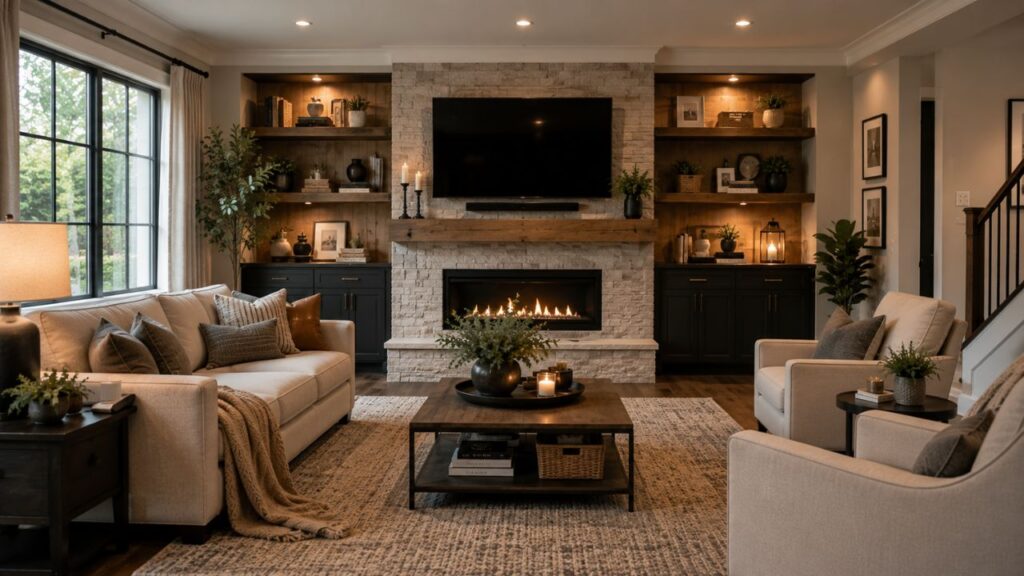
Why the Fireplace and TV Placement Decision Matters So Much
Most living rooms are built around a single dominant wall. The problem is that fireplaces and televisions both want to own that wall. When they compete, the room feels unsettled — seating arrangements get awkward, sightlines get compromised, and the space never quite comes together.
The layout you choose affects everything downstream: where your sofa goes, how natural light interacts with the screen, whether guests crane their necks, and how the room reads visually from the entryway. Getting this right early saves you from expensive rearrangements later.
Interior designers consistently note that the living room with fireplace and tv combination works best when one element is designated the visual anchor and the other is integrated thoughtfully rather than competing. Which one leads depends on your priorities, your room’s architecture, and how you actually use the space.
TV Above the Fireplace: The Most Popular Approach (And Its Real Trade-Offs)
Placing the tv above the fireplace is the go-to choice for millions of homeowners, and it’s easy to see why. It unifies the focal wall, simplifies furniture arrangement, and creates a clean, intentional look. TV above fireplace ideas have dominated design magazines and Pinterest boards for over a decade because they genuinely look polished when done right.
But there are real concerns worth taking seriously before you commit.
The Heat and Height Problem
The single biggest issue with mounting tv above fireplace setups is heat exposure. Heat rises, and a wood-burning or gas fireplace generates significant upward thermal movement. Most manufacturers specify a maximum operating temperature for their televisions — typically between 95°F and 104°F — and direct heat exposure over time can degrade internal components, particularly the display panel and circuit boards.
Before you finalize a tv above gas fireplace installation, measure the ambient temperature at the wall location where the TV will sit. Do this with the fireplace running at normal intensity for 30 minutes. If the surface temperature exceeds 90°F, you’ll want to reconsider placement or install a proper heat deflector — a sloped metal shelf mounted between the firebox and the TV that redirects heat forward and away from the wall above.
Can you put a tv above a fireplace safely? Yes, in most cases — but it requires the right conditions. Gas fireplaces that vent to the exterior and have sealed glass fronts are generally safer than open wood-burning setups. The viewing angle is the other issue. Mounting too high forces you to look up for extended viewing, which causes neck strain during longer sessions. Ideally, the center of the screen should sit no more than 15 degrees above your eye level when seated.
Making the Viewing Angle Work
Articulating wall mounts are your best friend in a tv above fireplace scenario. Unlike fixed mounts, these allow you to tilt the screen downward — often 15 to 20 degrees — which compensates for the elevated mounting height and brings the viewing angle into a comfortable range.
Look for mounts rated for your TV’s weight with a minimum 15-degree downward tilt capability. Brands like Sanus, Vogel’s, and Monoprice offer reliable options at various price points. Installing a mount that allows full-motion articulation also lets you swing the screen slightly left or right depending on where you’re seated.
Can You Put a TV Over a Gas Fireplace? What You Need to Know
The question of whether you can put a tv above a gas fireplace comes up constantly, and the answer is nuanced. Unlike wood-burning fireplaces — which produce open flames, unpredictable heat spikes, and occasional sparks — gas fireplaces offer more controlled heat output, especially modern direct-vent models.
Can you put a tv over a gas fireplace? Generally yes, with precautions. Mounting tv over gas fireplace installations have become standard practice, and manufacturers of modern gas units often design their products with tv above placement in mind. Some even include built-in heat deflectors or specify safe installation clearances in their documentation. Always check your specific gas fireplace manual for the manufacturer’s recommended clearance distances before mounting anything above the firebox.
Tv over gas fireplace setups work particularly well with electric inserts and contemporary linear gas fireplaces, which tend to distribute heat more horizontally rather than directing it straight up the wall. If you’re working with an older gas unit, a professional HVAC technician or fireplace installer can assess heat distribution and recommend appropriate protective measures.
Cable Management for a Clean Look
Nothing undermines a beautiful fireplace with tv setup faster than a tangle of visible cables dropping down the wall. In-wall cable management systems — essentially conduit channels routed inside the drywall — create the cleanest result. Brands like DataComm offer recessed power kits designed specifically for this purpose, routing both power and HDMI cables cleanly behind the wall.
If in-wall routing isn’t feasible (as with brick or stone fireplaces), surface-mounted cable raceways in a color matched to your wall finish are the next best option. Plan your cable routing before mounting anything permanently.
How to Mount TV Above Fireplace: A Step-by-Step Overview
Knowing how to mount tv above fireplace correctly makes the difference between a safe, lasting installation and one that fails. Here’s the process broken down.
What You’ll Need
- Stud finder
- Level
- Drill and appropriate bits (masonry bits for brick or stone)
- Articulating TV wall mount rated for your TV’s size and weight
- Toggle bolts or masonry anchors if studs aren’t accessible
- Cable management solution
How to Mount a TV Over a Fireplace
Start by locating wall studs using a stud finder. Most TV mounts require attachment to at least two studs for structural integrity. Mark stud centers clearly with pencil.
Next, determine mounting height. Measure from the floor to the fireplace mantel top, then add the necessary clearance distance per your fireplace manufacturer’s specs (often 12 to 18 inches minimum). Calculate where the screen center will land and compare it to seated eye level — you want minimal upward viewing angle.
For those asking how to mount tv on stone fireplace surfaces specifically — masonry anchors rated for the appropriate load are essential here. Tapcon screws work well in solid stone and brick. Use the correct masonry bit size as specified on the anchor packaging, drill to proper depth, and ensure anchors are fully seated before loading them with any weight.
Once the mount bracket is secured to the wall, attach the mounting arms to the TV according to the mount’s instructions, then hang the TV on the bracket. Confirm level, test articulation, and run cables before finalizing any finishing work.
TV and Fireplace Wall Layouts Beyond “TV Above”
While mounting the TV above the fireplace is popular, it’s not the only approach — and for some rooms and lifestyles, it’s not the best one. The tv and fireplace wall offers several design configurations worth considering.
Side-by-Side Arrangement
When wall width allows, placing the TV and fireplace on the same wall but at the same height — separated by built-ins, shelving, or cabinetry — creates a balanced, symmetrical look. This approach solves the heat problem entirely and keeps the TV at proper eye level. It works especially well in wider rooms and allows for substantial storage and display space between and around both elements.
Living room tv over fireplace ideas tend to dominate online searches, but designers often favor the side-by-side configuration for large family rooms because it creates a more comfortable viewing experience during long movie or sports sessions.
Opposite Walls
In some floor plans, placing the TV and fireplace on opposite walls actually makes the most functional sense. The fireplace remains a visual and atmospheric anchor when in use, while the TV occupies a dedicated entertainment wall optimized purely for viewing. Furniture floats in the center, angled to address both directions as needed.
This works particularly well in open-plan spaces where the room has multiple functional zones. The trade-off is that you’re rarely fully enjoying both simultaneously — but for homeowners who don’t watch TV while the fire is burning, this is a non-issue.
Fireplace Under TV: Built-In Solutions
The fireplace under tv approach — common in modern media console designs — places an electric or gas fireplace insert inside a media unit directly below the television. These all-in-one solutions offer excellent heat management (heat disperses from the sides, not upward toward the screen), a cohesive aesthetic, and simplified installation. Dimplex, Napoleon, and Touchstone make well-regarded options in this category.
This is an increasingly popular choice for living room fireplace decor with tv above because it allows precise control over heat direction and gives you a fully integrated, furniture-based solution rather than a built-into-the-wall approach.
[IMAGE: Modern living room with built-in media unit featuring fireplace under TV, flanked by floating shelves with books and decorative objects]
Fireplace Decor Ideas With TV: Styling the Combined Focal Wall
Once placement and mounting are sorted, styling the space transforms a functional solution into a genuinely beautiful room. Fireplace decor ideas with tv need to treat both elements as part of a unified composition rather than two separate things sharing a wall.
The Mantel as Design Anchor
Even when the TV sits above the fireplace, the mantel remains a critical styling surface. Keep mantel decor appropriately scaled — nothing so tall that it crowds the TV above, nothing so small that the shelf reads as an afterthought.
A grouping of objects at varying heights (candleholders, a framed art piece, a sculptural object, perhaps a small plant) creates visual interest without clutter. Stick to a limited palette — three tones at most — so the mantel composition reads cleanly from across the room.
Managing the TV’s Off-State Appearance
A dark, blank screen reads as a void on the wall when the TV is off. Several approaches minimize this. A gallery wall arrangement on either side of the screen draws the eye horizontally and reduces the visual weight of the blank screen. Alternatively, Samsung’s Frame TV — which displays artwork when not in active use — is purpose-designed for above-mantel installations and is genuinely popular in design-forward living rooms.
For modern fireplace with tv above setups, full-height stone, tile, or shiplap cladding on the focal wall helps visually integrate the two elements so neither feels like an afterthought. The cladding creates a unified surface that connects the firebox below to the screen above.
Symmetry and Balance
Flanking built-ins or floating shelves on either side of the fireplace-and-tv wall add storage, display opportunities, and — most importantly — visual balance. They frame the focal wall in a way that makes the entire composition feel complete. Built-ins also provide an excellent location for your AV equipment, hiding receivers, streaming devices, and game consoles cleanly out of sight.
Furniture Arrangement for a Living Room With Fireplace and TV
The best mounting solution and styling in the world won’t save a room with awkward furniture placement. In a living room with fireplace and tv, your seating arrangement must work with both elements simultaneously.
The primary sofa should face the focal wall directly, positioned at a distance appropriate for your TV screen size. A general guide: for a 65-inch TV mounted at height, optimal seating distance is typically 8 to 10 feet from the screen. Confirm this feels right in your specific room.
Accent chairs and secondary seating can angle slightly toward the center of the room to facilitate conversation, while still maintaining a reasonable sightline to the screen. An area rug anchors the seating group and visually defines the space. Choose a rug large enough that at minimum the front legs of all major seating pieces rest on it — this connects the furniture arrangement into a cohesive zone.
Avoid pushing all furniture against the walls. Floating the seating group toward the center of the room actually makes spaces feel larger and creates a more intentional, designed layout.
Frequently Asked Questions
Can you put a TV above a fireplace without damaging it?
Yes, in most cases, but heat management is critical. Measure the ambient wall temperature at mounting height with the fireplace running before committing to placement. For gas fireplaces with sealed fronts and exterior venting, heat exposure is generally manageable with proper clearance and a heat deflector if needed.
What is the ideal height for mounting a TV above a fireplace?
The center of the screen should ideally sit no more than 15 degrees above your eye level when seated. For most standard seating heights, this means the screen center falls around 42 to 48 inches from the floor — which is why mounting too high above a tall mantel can create viewing discomfort. An articulating mount with downward tilt helps compensate.
How do you hide cables when mounting a TV over a fireplace?
In-wall cable management is the cleanest solution for drywall surfaces. DataComm and similar brands make recessed power kits designed specifically for above-fireplace TV installations. For brick or stone fireplaces, surface-mounted raceways painted to match the wall finish are the practical alternative.
Is it safe to mount a TV above a gas fireplace?
Mounting a TV above a gas fireplace is safe when done correctly. Direct-vent gas fireplaces with sealed glass fronts are significantly safer than open wood-burning alternatives. Always check your gas fireplace manufacturer’s documentation for clearance requirements, and consider a heat deflector for additional protection.
What type of TV mount works best above a fireplace?
A full-motion articulating mount with downward tilt capability is the best choice for above-fireplace installations. This allows you to angle the screen downward toward your seated eye level, compensating for the elevated mounting position. Look for mounts rated for your specific TV size and weight.
How do you style a mantel when the TV is above it?
Keep mantel styling scaled appropriately — nothing so tall it crowds the screen above. A curated grouping of objects at varying heights, in a limited color palette, creates visual interest without clutter. Avoid symmetrical arrangements that feel stiff; slight asymmetry tends to look more natural and editorial.
What are the best alternatives to mounting a TV above the fireplace?
Side-by-side placement with flanking built-ins, a TV on the opposite wall, or an all-in-one media console with a built-in electric fireplace are all strong alternatives. The best choice depends on your room’s proportions, how you use the space, and your comfort with the viewing angle that above-mantel mounting creates.
Can I mount a TV on a stone fireplace wall?
Yes — masonry anchors like Tapcon screws provide strong attachment points in stone and brick surfaces. Use the correctly sized masonry drill bit for your anchor specifications, drill to the required depth, and ensure anchors are fully seated and appropriately rated for your TV mount’s weight load.
Final Thoughts
Designing a living room with fireplace and tv that genuinely works requires thinking through placement, safety, mounting, and styling as an integrated set of decisions rather than individual problems to solve in sequence. When you approach it that way — considering heat exposure before you mount, thinking about viewing angles before you finalize height, planning cable management before you drill — the process is far smoother and the results are far more satisfying.
There’s no single right answer. Some rooms are built for a TV above fireplace configuration. Others work better with side-by-side built-ins or an opposite-wall entertainment setup. The goal isn’t to copy a Pinterest image — it’s to create a living room with fireplace and tv that fits how your household actually lives, looks beautiful, and doesn’t require adjustments six months later.
Take the time to plan carefully, invest in quality mounting hardware, and approach the styling as a composition rather than an afterthought. The result — a warm, functional, visually cohesive room that serves your family well — is absolutely worth the effort.