

My neighbor spent four months and just under $40,000 waiting on a mason to finish her backyard grill station. Two doors down, another family had a fully functioning island — appliances installed, countertop sealed, first steaks already on the grill — in a single weekend. The difference wasn’t budget. It was the build method. One went custom. One went RTA.
That gap is exactly why so many homeowners searching for outdoor kitchen designs keep running into the same three letters over and over: RTA. If you’re trying to figure out whether rta outdoor living is legitimate, whether the kits hold up outdoors, and how the whole rta outdoor kitchen process actually works once you click “order,” this is the guide I wish existed before I started researching my own backyard project.
I’ve spent the last several weeks digging through customer case studies, comparing material specs, reading through dozens of unfiltered rta outdoor living reviews, and cross-checking manufacturer claims against what actual buyers reported after installation. Here’s everything that matters.
Who Is RTA Outdoor Living, Really?
RTA stands for Ready-to-Assemble, and the company builds exactly what the name promises: pre-engineered outdoor kitchen islands that ship to your driveway in flat panels and go together with basic hand tools, usually in an afternoon. The brand manufactures its own products domestically, casting concrete panels and countertops at a facility in Cambridge City, Indiana, rather than outsourcing production overseas the way a lot of competitors do.
That matters more than it sounds. A huge chunk of the outdoor kitchen cabinet market is built on imported components, which means longer lead times, less quality control, and warranty headaches when something arrives damaged. Because rta outdoor production happens in-house, the company controls the entire chain — casting, curing, quality inspection, and shipping — under one roof.
The core pitch is simple: give homeowners a genuinely custom-feeling outdoor kitchen without the six-month contractor timeline, the change-order surprises, or the need to source a grill from one company, a fridge from another, and a countertop from a third. That “one-stop-shop” structure is the single biggest thing that separates rta outdoor cabinets from a traditional masonry build.
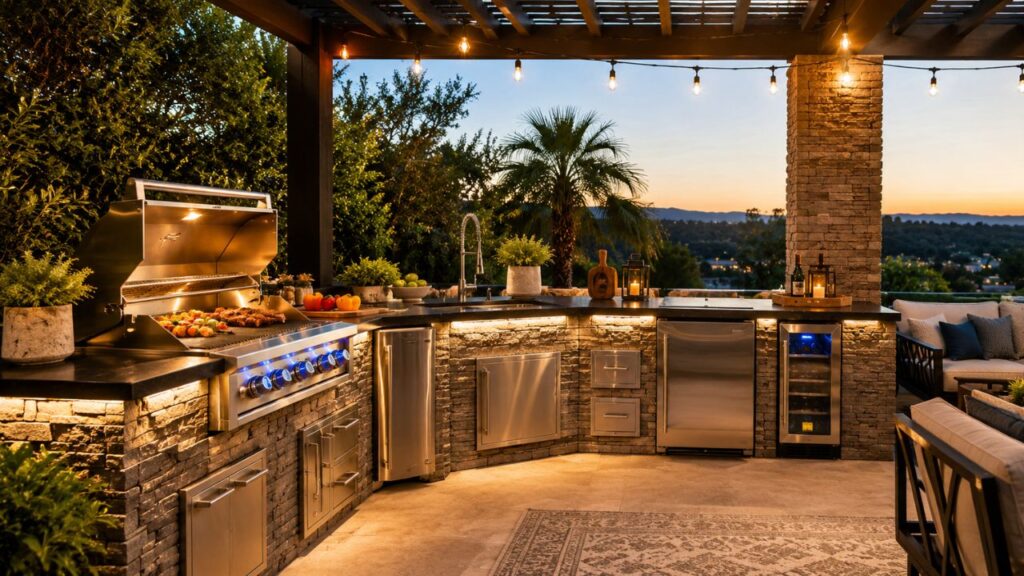
How RTA Outdoor Kitchens Are Actually Built
Every island starts as a monolithic, single-layer concrete structure rated to last roughly a century under normal outdoor exposure. This is a meaningful engineering choice. Many budget outdoor kitchen cabinets are built from stacked or layered materials — a substrate, a veneer, a sealant coat — and every added layer is another seam where moisture, freeze-thaw cycles, or UV exposure can eventually cause separation. A single poured layer removes that failure point entirely.
Buyers choose from a menu of finishes: light, medium, or dark concrete tones, granite or quartz countertops, and powder-coated cabinet options for a more modern look. There’s also the newer MOKS line — modular panels made from marine-grade composite material — aimed at people who want a faster, lighter-weight build with a more contemporary aesthetic and a same-day assembly window.
Here’s a side-by-side of what you’re actually choosing between:
| Feature | Traditional Masonry Build | RTA Modular Kit | RTA MOKS Line |
|---|---|---|---|
| Typical timeline | 8–20 weeks | 1–7 days | Same day |
| Assembly | Licensed contractor required | DIY-friendly, basic tools | DIY-friendly, minimal tools |
| Base material | Site-poured concrete/block | Single-layer cast concrete | Marine-grade composite panel |
| Appliance sourcing | Buyer coordinates separately | Included (Coyote) | Included (Coyote) |
| Weather durability | Depends on mason’s skill | Engineered, warrantied | Engineered, warrantied |
| Customization | Fully custom | Semi-custom configurator | Pre-configured layouts |
The Coyote Partnership: Why It’s the Backbone of the Brand
You can’t talk about rta outdoor living without talking about coyote outdoor living. The two companies operate as strategic partners, and Coyote is the exclusive appliance supplier baked into every RTA kitchen kit. That means when you order a grill island, you’re not just getting cabinetry — you’re getting a fully matched appliance package from a brand that’s built a serious reputation of its own in the outdoor cooking space.
Coyote outdoor got its start in 2010, right as demand for built-in residential grills started taking off, and it’s grown into one of the more respected names in the mid-to-premium outdoor appliance tier. The company is based in Dallas, Texas, and designs its equipment domestically even though manufacturing happens overseas — a detail worth knowing since plenty of competing “American” grill brands do the exact same thing without saying so plainly.
What actually stands out about coyote appliances isn’t marketing language, it’s the spec sheet. Grills are built from 304-grade stainless steel, which resists corrosion far better than the 430-grade steel a lot of cheaper built-ins use. The lineup includes:
- Gas grills in the C-series (workhorse, straightforward) and S-series (more features, Infinity burners, sear zones)
- The newer Gen 3 line, which pushes further into high-output searing and hybrid cooking
- Pellet grills for smoking and low-and-slow cooking
- Charcoal grills for a more traditional cooking method
- Outdoor refrigeration, ice makers, sinks, and side burners designed to match the same footprint as the cabinetry
Because every coyote outdoor kitchen component is engineered to the same dimensional standards as RTA’s cabinet system, cutouts line up correctly the first time — which is the whole point of pairing appliances and cabinetry from a single coyote outdoor kitchen partnership instead of mixing brands. That sounds minor until you’ve heard the alternative story — someone ordering a fridge from one manufacturer and a cabinet from another, only to discover the vent clearance is wrong.
Outdoor Kitchen Design: What Actually Goes Into Planning One
A lot of people start their search looking for outdoor kitchen plans the way they’d look for a template — something to copy exactly. That’s the wrong starting point. Good outdoor kitchen design starts with three questions that have nothing to do with materials:
- How do you actually cook? A weekend griller with two kids needs a completely different layout than someone who hosts fifteen people every Saturday from May through September.
- What’s your traffic pattern? The kitchen needs a “work triangle” the same way an indoor kitchen does — grill, prep space, and storage should form a natural loop, not a straight line you keep walking back and forth across.
- What’s your climate doing to the materials? Coastal humidity, desert UV exposure, and Midwest freeze-thaw cycles all punish different materials in different ways. A cabinet that thrives in Arizona might warp near the Gulf Coast.
RTA’s free online configurator handles a surprising amount of this decision-making for you. You pick a footprint — linear, L-shaped, or U-shaped — set your dimensions, and layer in appliances, storage, and finish. A design team member reviews the layout before production starts, which catches spacing and clearance issues before they become expensive mistakes. There’s also a VR walkthrough feature in RTA’s app that lets you see the finished island in your actual space before a single panel gets poured, which is genuinely useful for catching scale problems on paper plans that look fine on a screen but feel wrong once you’re standing in the yard.
If you’re comparing outdoor kitchen designs across brands, pay attention to whether the appliance brand is locked in or flexible. Some competitors — Urban Bonfire is a good example — sell cabinetry only and let you source your own grill from Hestan, Lynx, DCS, Weber, Bull, or Blaze. That flexibility can be appealing if you already have a grill preference, but it also means you’re the one responsible for making sure cutouts, gas lines, and electrical match up.
Choosing an Outdoor Kitchen Builder: DIY vs. Contractor vs. RTA
There are really three paths, and each one solves a different problem.
Hiring a traditional outdoor kitchen builder. This gets you the most creative freedom — curved islands, mixed materials, integrated pergolas, whatever you can dream up. It also comes with the widest cost range, the longest timeline, and the most dependency on finding a contractor who’s actually good at outdoor-specific construction (a lot of general contractors treat outdoor kitchens as an afterthought, and it shows in the finished product).
Going fully DIY from scratch. Cheapest option on paper, but it demands real masonry, gas-line, and electrical skills, plus the patience to source every single component yourself. Most first-timers underestimate how many small parts an outdoor kitchen actually needs.
Ordering a modular RTA kit. This sits in the middle — professional engineering and a matched appliance package, but assembly you (or a friend with a drill) can realistically finish in a day or a weekend. It’s not truly “custom” in the architectural sense, but the configurator gives you enough flexibility that most buyers don’t feel boxed in.
For anyone weighing cost against control, this comparison table is a useful gut check:
| Priority | Best Fit |
|---|---|
| Lowest possible price, don’t mind full DIY | Scratch-built with sourced components |
| Fastest timeline with professional engineering | RTA modular kit |
| Maximum architectural customization | Licensed outdoor kitchen builder |
| One-stop appliance + cabinet sourcing | RTA + Coyote package |
| Contemporary look, tightest budget | RTA MOKS composite line |
What Real Customers Say: RTA Outdoor Living Reviews
I read through a wide range of rta outdoor living reviews across the company’s own site, third-party retailers, and independent home-renovation bloggers, and a few themes came up again and again.
The most consistent praise centers on the design and project-management process. Buyers repeatedly mention specific staff members by name — a sign of a company where the sales and design process isn’t purely transactional — and describe the team walking them through each step with instructional videos before parts even ship. Several reviewers who went in nervous about DIY assembly reported finishing a full L-shaped island with a grill, refrigerator, and bar section in roughly six hours with a friend’s help, no professional contractor involved.
On the appliance side, owners who chose the Coyote package consistently described the build quality as “restaurant grade,” specifically calling out the grill, flattop, refrigerator, and sink units for holding up well under regular use.
Where complaints show up, they tend to cluster around two things: shipping damage on individual panels (which the company’s warranty and replacement process is generally reported to resolve, though it adds delay) and sticker shock for buyers who assumed “ready-to-assemble” automatically meant “budget.” It doesn’t. RTA sits in the mid-to-premium tier, not the entry-level tier — you’re paying for engineering and appliance quality, not just convenience. That’s a trade-off most buyers accept once they compare warrantied rta outdoor cabinets against cheaper, unproven imports that don’t hold up past a couple of seasons.
If you want a fast way to sanity-check your own project, pull up rta outdoor living photos on the brand’s site or Instagram before you finalize a layout. Seeing finished islands in real backyards — not just studio renderings — makes it much easier to judge scale, finish tone, and how a given configuration actually reads in daylight versus how it looks in a polished marketing photo.
Materials Deep Dive: What Actually Holds Up Outdoors
This is the part most buyers skip, and it’s the part that determines whether your kitchen looks good for three years or twenty.
Concrete (RTA’s core line). Dense, heavy, and extremely resistant to impact and heat. The tradeoff is weight — these islands need a stable, level base and aren’t something you casually relocate later.
HDPE (high-density polyethylene). Common across the industry for its resistance to moisture and UV fading. It won’t rot, rust, or splinter, and it’s the material most frequently recommended for coastal or high-humidity climates.
Marine-grade composite (used in RTA’s MOKS line). Lighter than concrete, faster to assemble, and still built to handle direct sun and rain exposure, though it trades some of concrete’s mass and heat resistance for speed and a more modern aesthetic.
Stainless steel (304-grade, used across Coyote appliances). The 304 designation matters because it contains more chromium and nickel than the 430-grade steel used in cheaper built-ins, which translates directly into better rust and corrosion resistance over time — especially important within a few miles of saltwater.
A quick comparison for anyone still deciding:
| Material | Best Climate Fit | Weight | Relative Cost |
|---|---|---|---|
| Cast concrete | All climates, especially freeze-thaw regions | Heavy | Mid-premium |
| HDPE | Coastal, high-humidity | Light-medium | Mid |
| Marine-grade composite | Most climates, fast builds | Light | Mid |
| 304 stainless (appliances) | All climates, especially coastal | Heavy | Premium |
Step-by-Step: What Actually Happens When You Order
- Design consultation. You either build a layout yourself in the online tool or work with an RTA designer directly, choosing footprint, finish, and appliances.
- Quote and confirmation. A finalized blueprint and price get sent for approval before anything goes into production.
- Production. Panels are cast, cured, and inspected at the Indiana facility. This stage typically takes the bulk of the lead time, not shipping.
- Delivery. Kits ship nationwide, generally arriving as palletized, labeled panels rather than one oversized crate.
- Assembly. Most linear and L-shaped kits go together in a matter of hours using basic tools; larger U-shaped configurations may take a full weekend.
- Final hookup. A licensed plumber or gas technician should handle final gas line and electrical connections — this part isn’t a DIY step, regardless of how the cabinetry assembly goes.
Common Mistakes to Avoid
- Skipping the site survey. Uneven ground is the number-one cause of post-install headaches. Get your pad leveled and confirmed before panels arrive.
- Underestimating storage needs. It’s tempting to prioritize appliances and treat storage as an afterthought, but pull-out spice racks, dry pantries, and trash drawers are what make a kitchen actually livable long-term.
- Ignoring prevailing wind direction. Grill smoke blowing straight into a dining area ruins an otherwise perfect layout. Check your yard’s typical wind pattern before finalizing orientation.
- Choosing finish based on a screen, not daylight. Concrete and countertop tones shift dramatically under direct sun versus indoor lighting. Cross-reference actual rta outdoor living photos taken outdoors, not just studio shots.
- Forgetting utility rough-in timing. Gas, water, and electrical stub-outs need to be placed before the island lands on the pad, not after.
RTA vs. the Rest of the Market
The broader outdoor cabinet market includes a handful of recognizable names, and it’s worth knowing where each one sits. Danver has been in the space since the 1990s and also produces the cabinetry sold under the Brown Jordan and Trex outdoor kitchen names — all built-to-order rather than modular. Urban Bonfire offers roughly fifty pre-configured cabinet layouts plus a custom option, but sells appliances separately, meaning you’re responsible for matching a grill brand to their cabinet dimensions yourself. Against that field, the thing that consistently sets an outdoor kitchen rta purchase apart is the bundled, pre-matched appliance package — you’re not assembling a kitchen from three different vendors’ spec sheets and hoping the cutouts align. Search “outdoor kitchen rta” and you’ll notice most competitors don’t even bundle appliances the same way, which is really the deciding factor for a lot of buyers.
Final Verdict
If you want full architectural freedom and don’t mind a longer timeline and a wider budget range, a custom-built kitchen from a local outdoor kitchen builder is still the right call. But for the large majority of homeowners who want a genuinely durable, professionally engineered outdoor kitchen without a months-long construction project, RTA’s modular system solves a real problem — and does it with an appliance partner in Coyote that’s earned its reputation the hard way, through repeat customers and strong warranty support rather than just marketing spend.
The rta living approach isn’t for everyone. But for anyone who’s ever stared at a bare concrete patio and pictured a working outdoor kitchen instead, it’s one of the fastest, most realistic ways to get there. If the phrase “rta living” keeps showing up in your research, that’s not a coincidence — it’s usually a sign the brand has already earned a lot of repeat, word-of-mouth customers.
Frequently Asked Questions
Is RTA Outdoor Living a legitimate company? Yes. RTA manufactures its own products domestically at a facility in Cambridge City, Indiana, and has an established track record of documented customer reviews, an active design and support team, and a formal partnership with Coyote Outdoor Living for appliances.
How long does it take to assemble an RTA outdoor kitchen? Most linear and L-shaped kits are reported to go together in a matter of hours with two people and basic hand tools. Larger U-shaped configurations or full custom builds can take a full weekend. The MOKS composite line is designed for same-day assembly.
Do I need a contractor to install an RTA kitchen? The cabinetry assembly itself is designed to be DIY-friendly. However, final gas line and electrical hookups should always be completed by a licensed professional, regardless of how the structure was assembled.
What appliances come with an RTA outdoor kitchen? RTA has an exclusive partnership with Coyote Outdoor Living, so grills, refrigerators, sinks, side burners, and storage components are all sourced from Coyote and engineered to match the cabinet dimensions precisely.
Is RTA more expensive than a standard outdoor kitchen cabinet brand? Generally yes. RTA sits in the mid-to-premium tier because you’re paying for engineered, single-layer concrete construction and matched premium appliances, not just flat-pack cabinetry.
What’s the difference between RTA’s standard line and the MOKS line? The standard line uses single-layer cast concrete construction with granite, quartz, or powder-coated finish options. MOKS uses lighter marine-grade composite panels designed for faster assembly and a more contemporary look.
Can I see real installed kitchens before ordering? Yes — RTA’s website and social channels feature customer-submitted photos of completed builds, which is a far more reliable way to judge finish tone and scale than rendered marketing images alone.
Will an RTA outdoor kitchen hold up in a coastal or humid climate? The materials used across the line — cast concrete, marine-grade composite, and 304-grade stainless steel appliances — are specifically chosen for weather and corrosion resistance, making them a reasonable fit for coastal conditions when properly maintained.